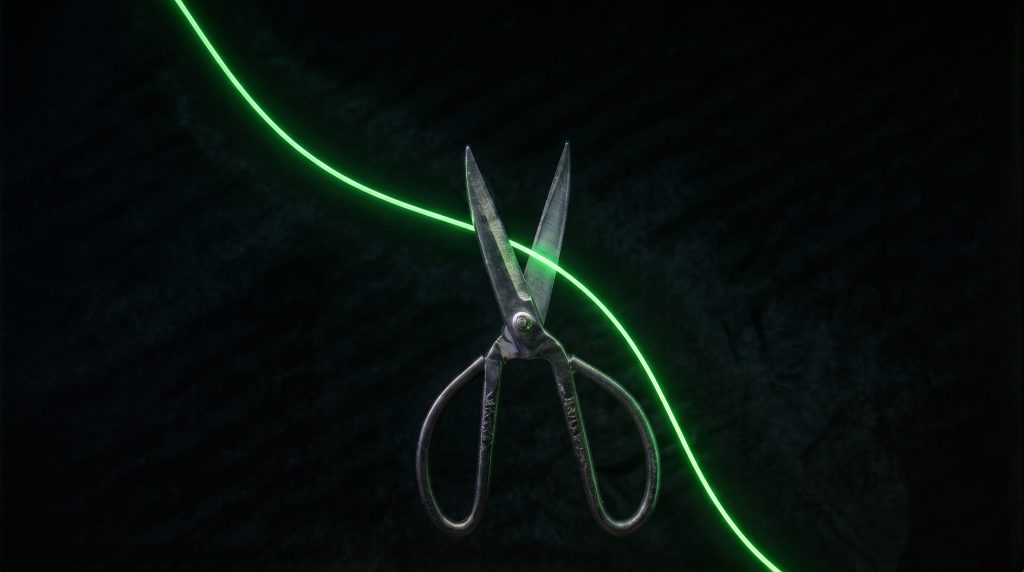
If there's one skill that separates traders who last from those who disappear from the markets, it's not their ability to find the perfect entry point. It's their ability to cut their losses while trading.
At first glance, this rule seems obvious. Yet, when a position moves against us, it becomes one of the most difficult decisions to make. Why? Because selling a losing position means admitting that our scenario was wrong. Our instinct then pushes us to wait for a rebound, move our stop-loss order, or convince ourselves that "the market will come back."
In futures trading, this reaction can be very costly. The more a loss accumulates, the more it ties up your capital, margin, and mental energy. What started as a losing trade can quickly become an obstacle preventing you from seizing future opportunities.
That's why cutting your losses in trading isn't simply about limiting a loss. It's a strategic choice that allows you to protect your capital, maintain your discipline, and continue executing your trading plan with peace of mind.
In this article, we will understand why this decision is so difficult to make, what psychological mechanisms are involved, and why knowing how to cut your losses is above all a way to build future performance.
Why cutting your losses is counterintuitive
One of the main difficulties of trading is that it often requires us to act in the opposite way to what our brain naturally dictates.
In everyday life, we are encouraged to persevere. We are taught not to give up at the first obstacle, to hold on when difficulties arise, and that efforts are eventually rewarded.
This way of thinking works in many areas. However, financial markets operate according to a completely different logic.
When a scenario is invalidated, persisting in it changes nothing. The market knows neither your entry price, nor your expectations, nor the time spent on your analysis. It evolves independently of your convictions.
However, when a position becomes unprofitable, our first instinct is rarely to exit. We often prefer to wait "a little longer ." We hope for a technical rebound, a favorable economic announcement, or simply a return to the break-even point that would allow us to close the position without a loss.
This waiting period provides a temporary feeling of comfort.
However, it delays a decision that should often have been made earlier. It is precisely this mechanism that transforms an acceptable loss into a significant one.
Psychology explains why it is so difficult to sell
If cutting losses in trading was solely a matter of technique, all traders would respect their stop-loss orders without difficulty.
In reality, the main obstacle is psychological.
Several cognitive biases directly influence how we react to a losing position.
- Loss aversion : we feel the pain of a loss much more strongly than the pleasure provided by an equivalent gain.
- The sunk cost bias The more time, energy, or money we have invested in a position, the harder it becomes to accept that it is not working.
- Lego Recognizing that our scenario was wrong is often more difficult than accepting a financial loss.
However, a professional trader does not seek to be right.
He seeks to implement his trading plan with discipline.
This nuance is essential.
A losing trade can be perfectly executed.
Conversely, a winning trade obtained by ignoring risk management rules remains, in many cases, a bad trade.
In futures trading, a loss costs much more than money.
When talking about losses, most traders immediately think of the amount displayed on their platform.
However, in Futures trading, the real cost of poor management goes far beyond the purely financial aspect.
A losing position has several consequences.
- It reduces your available capital.
- It ties up part of your profit margin.
- It limits your ability to seize a new opportunity.
- It requires considerable mental energy.
The psychological cost is often the most significant.
When a position continues to decline, the trader constantly checks their chart. Every few ticks of variation becomes a source of stress.
Gradually, he no longer makes his decisions based on his market analysis.
He takes them according to his NLP.
From that moment on, the mistakes piled up.
The stop sign has been moved.
The position is strengthened.
The trading plan has been forgotten.
In reality, it is no longer the market that directs the trader.
That's a loss.
Cutting your losses means protecting your strategy
Many believe that a loss marks the end of a trade. In reality, it marks the beginning of the next. This idea may seem paradoxical, but it perfectly summarizes the logic of professional trading.
Each position is just one trade among dozens, even hundreds, that will make up your results over the course of a year. When a scenario is invalidated, your role isn't to convince the market that you were right. Your role is to preserve the conditions that will allow you to exploit the next opportunity. That's why cutting a loss should be considered a management decision, not an emotional one.
By protecting your capital, you also protect your method.
You avoid having a single trade jeopardize weeks, or even months, of work. You also maintain the composure needed to objectively analyze future setups. In other words, cutting your losses in trading doesn't mean abandoning an idea.
It means choosing not to sacrifice an entire strategy to defend a single position.
The best traders think in terms of probabilities.
One of the biggest differences between a novice trader and an experienced trader lies in how they evaluate their performance.
Beginners often judge their skill level by the outcome of their last trade. A winning position boosts their confidence. A losing position calls their entire strategy into question. Professionals, however, take a much broader view. They know that no method offers a 100% success rate. Even a high-performing strategy experiences losing streaks. These losses are not anomalies; they are an inherent part of probability. This is precisely why risk management is more important than the success rate.
A strategy that can quickly accept small losses and let its gains run generally has more potential than a strategy that rejects losses and ends up experiencing much larger movements.
The best traders, therefore, do not seek to avoid losses.
They seek to avoid those that call into question their ability to continue trading.
A controlled loss paves the way for future gains
It is tempting to view a loss as a negative experience.
However, a controlled loss fulfills several essential functions.
It allows, in particular, to:
- confirm that a scenario was no longer valid;
- to reiterate the importance of adhering to one's trading plan;
- preserve the capital needed to exploit future opportunities;
- strengthen his discipline.
A controlled loss is also an excellent learning tool.
Each losing trade provides valuable information about the quality of the analysis, adherence to execution rules, and emotional management.
Successful traders are not those who never lose. They are those who honestly analyze their losses and use them to improve their decision-making process.
Over time, this approach gradually transforms loss into investment. Not a financial investment.
But it's an investment in the quality of his method.
Conclusion: Discipline before performance
Cutting losses in trading is probably the most difficult skill to acquire, as it goes directly against our natural reflexes.
However, it is also what determines a trader's longevity. In futures trading, it is impossible to control market movements. On the other hand, it is always possible to control the risk accepted on a position.
This difference is fundamental. A controlled loss does not mean you have failed.
It means that you have stuck to your plan, protected your capital and preserved your ability to act when the market offers a new opportunity.
Over time, a trader's career isn't built on a few exceptional trades. It's on hundreds of disciplined decisions, made methodically and consistently.
This is precisely why cutting losses in trading is not simply a risk management rule.
This is the rule that allows all the others to function.



 SPECIAL HOLIDAY OFFER!